How Debt Works: The Balance, the Interest, and Time
Track one balance and explain how an agreement, interest, time, payments, and later borrowing can change where it goes.
- 1 What You Know
- 2 Read, Pause & Note
- 3 Explain It
- 4 Review & Improve
- 5 Find What to Improve
Click a word to select it silently, then press Resume or Space.
PASSAGE 1 OF 4
The $30-a-Month Offer
1.1 Someone is looking at a $1,000 laptop. A sign beside it says, “Take it home today. Only $30 per month.” That sounds simple, but the sign leaves out two big answers: How much will the laptop cost after borrowing? And when will the debt be paid off?
1.2 If the person takes the laptop now and promises to pay later, they have a debt. The $1,000 they first borrowed is the original principal. As they pay back that borrowed money, the unpaid part is the remaining principal.
1.3 The current balance means the amount owed right now. It may include unpaid principal, interest, fees, or other charges allowed by the agreement. Interest is money charged for borrowing over time.
1.4 The price and the $30 payment do not show all the terms, or rules, of the agreement. What is the interest rate? How is interest worked out? How many payments are planned? Could there be fees? Could the person borrow more on the same account? Without these answers, the monthly payment does not tell the whole story.

1.5 Two people could each owe $1,000 today, but their debts could work differently. One agreement might have a planned final payment. Another might let the balance go up or down without a set ending.
1.6 A balance shows what has happened in an account. It does not tell us whether the person made a good or bad choice. Here, we are studying how the rules and numbers work.
1.7 To understand “$30 per month,” the person needs to read the agreement. Let’s see what happens when the same $1,000 goes into two different kinds of debt.
PASSAGE 2 OF 4
One Balance, Two Futures
2.1 Imagine putting $1,000 into two different agreements. At first, neither person borrows anything more. Both start with the same amount so we can see how the agreements differ.
2.2 Path A is a fixed-rate installment loan. The person borrows one amount and follows a planned payment schedule. If they follow it, the loan has a planned ending. A fixed rate does not mean the loan is cheap. Each payment also does not have to contain equal amounts of principal and interest.
2.3 Path B is a revolving credit-card account. It has a credit limit: the amount of credit the lender makes available under the agreement. Payments or credits can lower the balance, while interest can raise it. Paying down the balance can make credit available to use again.
2.4 The two paths differ even before anyone borrows more. Path A has a planned schedule for paying back one borrowed amount. Path B can carry a balance from one bill to the next without a set final payment date.
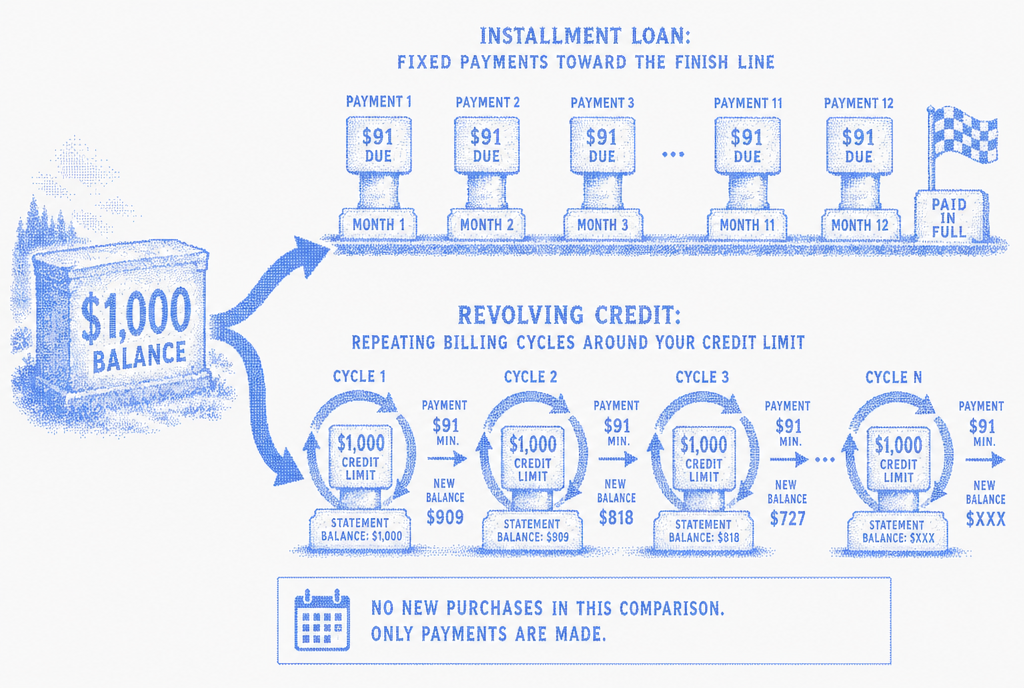
2.5 Now imagine the person on Path B buys a laptop accessory with the card. That new purchase raises the balance. But the new purchase did not create the difference between the two paths. The agreements were already different.
2.6 A credit-card statement shows what happened during one billing period. The statement balance is the amount shown when that period ends. The current balance can be different later if a payment, purchase, credit, fee, or interest is added after the statement was made.
2.7 The same $1,000 can now follow two different paths. On Path B, the balance might change even without another purchase. What happens if 30 days pass and interest is added?
PASSAGE 3 OF 4
The Clock Starts Adding Cost
3.1 Let’s follow Path B. The account carries a $1,000 balance from the month before. For the next 30 days, there are no new purchases, no fees, and no payments. We will look only at the interest added during that time.
3.2 In this made-up agreement, the APR is 24%. APR shows a rate for a whole year, but interest may be calculated over shorter periods. For this example, we will use a simple daily calculation and a 365-day year.
3.3 These are the rules for our example: the starting balance is $1,000, the APR is 24%, and no purchases, fees, or payments happen during the 30 days. We use a 365-day year and a simplified way of calculating daily interest.
- Carried balance: $1,000.00
- APR: 24%
- No new purchases
- No fees
- No payment during the 30 days
- 365-day year
- Simplified daily-interest illustration
3.4 Divide 24% by 365 to get the daily rate: about 0.06575%, or 0.0006575 as a decimal. In this example, one day of interest on $1,000 is about $0.66.
3.5 For this simple calculation, we use the same $1,000 balance each day. After 30 days, about $19.73 in interest has been added. The amount owed is now about $1,019.73.
- Day 0: $1,000.00
- One illustrative day: about +$0.66
- Thirty illustrative days: about +$19.73
- Balance after that interest: about $1,019.73
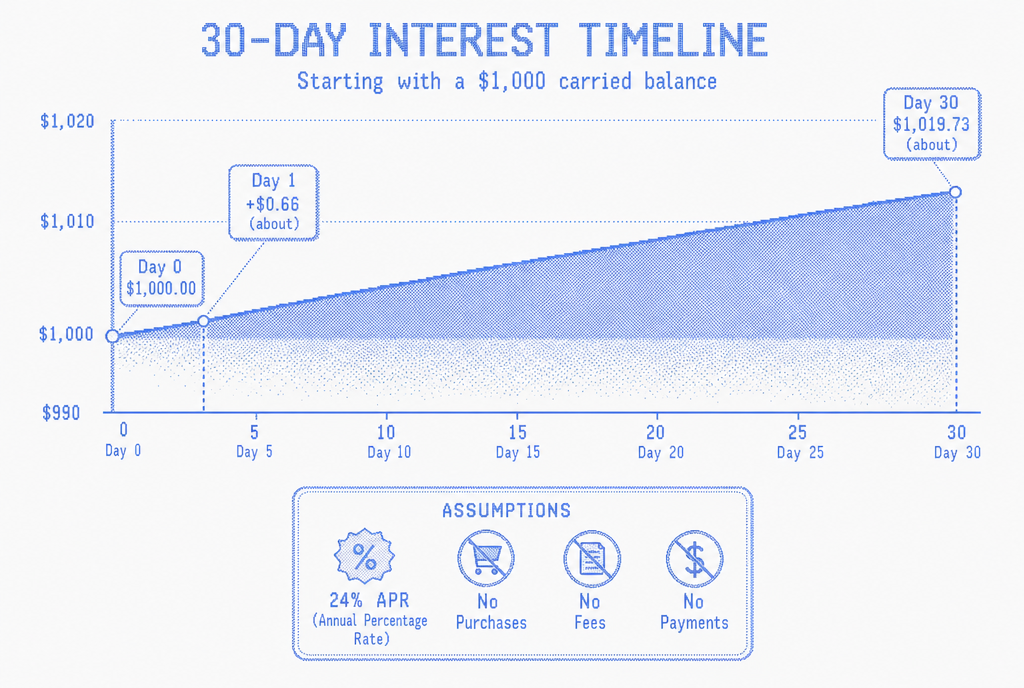
3.6 This example shows how interest can add cost. It does not predict every real credit-card bill. Real accounts may use different rates and ways of calculating interest. The account’s agreement tells you which rules apply.
3.7 If interest is calculated using daily balances, paying earlier can help because the larger balance is used for fewer days. But no payment was made during our 30 days. Now the person pays $30. Will the balance drop to $970?
PASSAGE 4 OF 4
The Payment Arrives
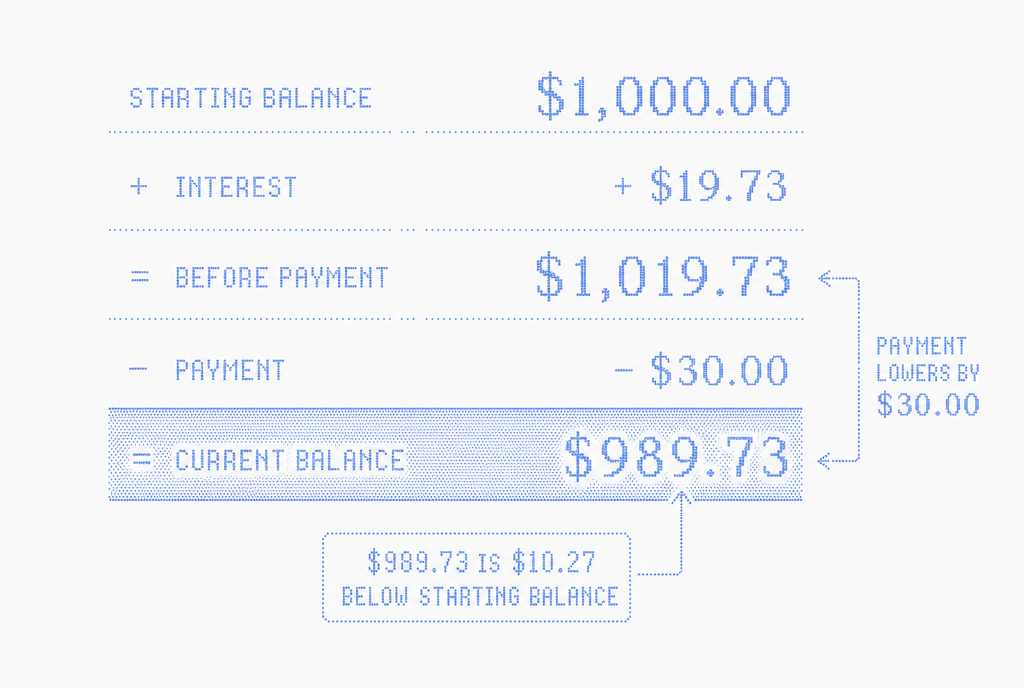
4.1 Before the payment, the person owes about $1,019.73. When the $30 payment is applied, the amount owed goes down by the full $30. The new current balance is about $989.73.
- Original carried balance: $1,000.00
- Illustrative interest added: +$19.73
- Balance before payment: $1,019.73
- Payment: −$30.00
- Remaining current balance: $989.73
4.2 The payment lowered the current balance by $30: from $1,019.73 to $989.73. But $989.73 is only $10.27 less than the original $1,000. Interest had raised the balance before the payment arrived.
4.3 The agreement may have rules for how payments are counted against interest, fees, or different parts of a balance. That does not mean any of the $30 vanished. The full payment lowered what was owed. The earlier interest explains why the ending balance is only $10.27 below the starting $1,000.
4.4 The offer said “only $30 per month.” On a credit-card account, $30 might be the minimum payment—the smallest payment required by the agreement. Paying it on time can keep the account up to date, but it does not mean the debt is paid off.
4.5 The unpaid balance can move into the next billing period, where more interest may be added. New purchases could change it again. Payments and credits can lower the balance; interest, fees, and purchases can raise it.
4.6 U.S. credit-card statements generally show an estimate of how long repayment would take if the person paid only the minimum each month and made no new charges. They generally also show an estimated monthly payment that would pay off the statement balance in three years. These are estimates based on stated assumptions, not promises about future spending.
4.7 “$30 per month” tells the person about a payment they may need to make now. It does not tell them the total cost or when the debt will end. The agreement, interest, time, payments, and any new borrowing shape what happens next.
EXPLAIN IT · FROM MEMORY · ON PAPER
What can you explain without looking?
You can write, draw, or make a map of your ideas. Finish before looking back, and keep this first try so you can see what changes later.
- How can two people each owe $1,000, but have debts that behave differently over time?
- Why can an APR printed as a yearly rate add cost during a single month, and why can an earlier payment matter when interest is accruing?
- Why can paying the minimum on a revolving credit-card account leave debt in place for a long time, even when the payment is on time?
CHECK AND IMPROVE · ON PAPER
Check your explanation
It’s normal to miss something or get part of it wrong on your first try. Checking helps you see what you understood and what needs another look.
Reopen the reading and turn your notes face up. Use a different color, and keep your first try visible.
- Add any important idea you missed.
- Fix anything you got wrong.
- Make any confusing part clearer.
- If an idea is already correct and clear, write “got it” beside it. You don’t need to find a mistake in everything.
Use these locations to compare your ideas with the reading. They show where to look—not what your answer should say.
- Question 1Passage 1, 1.1–1.7Passage 2, 2.1–2.7
- Question 2Passage 3, 3.1–3.7
- Question 3Passage 4, 4.1–4.7
FIND WHAT TO IMPROVE · ON PAPER
Choose one thing to try next
After you review and improve your answers, pick ONE strategy or way to improve for your next reading.
Look at your first answer and your different-color changes.
- What held up? Find one idea you explained clearly.
- What changed? Find the most important thing you added, corrected, or made clearer.
- What could help next time? Choose one small action to test during your next reading.
Choose from what you noticed
Choose one strategy to continue.